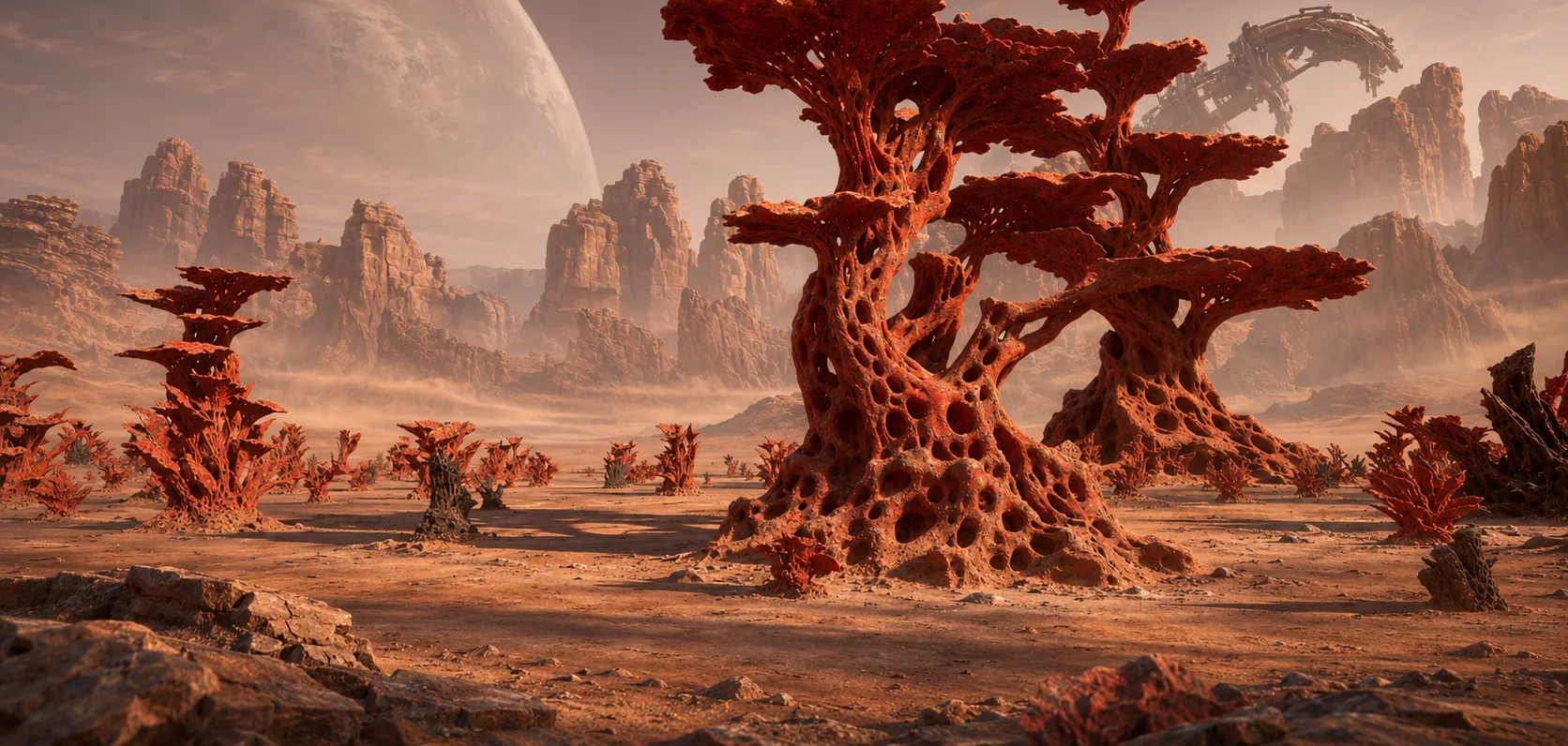
When I first imagined AURORA, I wanted its unknown planet to feel like a real place, not just a backdrop for collecting resources and building structures. The player should arrive in a world that existed long before them and follows rules of its own.
I knew from the beginning that I wanted a large open world. But the further development progressed, the clearer something became: the size of a map means very little on its own. If every hill reveals the same rocks, the same plants, and the same stretches of empty ground, exploring that world soon loses its appeal.
A Place You Can Get Lost In
AURORA's map spans 32 kilometers. That is an enormous space for a game I am building alone. It needs not only destinations worth reaching, but meaningful distances between them.
I like the idea that emptiness can be part of the atmosphere. A long journey across a rocky plain, one strange formation on the horizon, an abrupt change in terrain—sometimes those details stay with you longer than dozens of objects placed side by side.
That is why I try to think about the landscape as a whole: its silhouettes, changes in elevation, distinctive geological shapes, and what the player can recognize from a distance. I do not want to fill every part of the map just to make it seem busy.
Making the Ground Feel Real
The planet's surface has been a major area of work in its own right. Rock, sand, and different types of ground should not be distinguished by color alone. I want the texture, roughness, subtle relief, and transitions between surfaces to feel convincing.
Throughout development, I have returned to the landscape materials, adjusted how fine surface detail appears, and worked on the relationship between different ground types at close range and far away. Some of these changes have already been integrated into the project's materials. That does not mean the entire landscape is finished, though: steep slopes, surface transitions, and performance still need further validation.
That is true of many systems in AURORA. Getting something to work technically is only the beginning. The next question is whether it feels believable when you are standing inside the world.
Alien Life Should Grow in Its Own Way
One of the challenges is the vegetation. I do not want the plants to look like familiar Earth trees with slightly different colors. I am interested in forms that make you stop and look: strange trunks, organic structures, dense colonies, and stretches of almost bare ground around them.
But even strong individual models cannot make a convincing biome if they are simply scattered evenly across the terrain.
So I began working not only on the plants themselves, but also on how they are arranged. The project now has a biome composition system with clusters of vegetation, larger focal objects, open spaces, and transitions between dense and sparse areas. From a distance, I want these places to read as natural colonies, rather than collections of unrelated objects.
Early visual tests showed that the effect is possible, but not something a single setting can solve. In some experiments, the vegetation became one broad but still sparse mass; in others, individual plants remained too visually separate. I am still looking for the right balance between natural disorder and a distinct overall composition.
Rocks, Traces of the Past, and What Lies Below
The planet should have more to offer than its vegetation. I want distinctive geological formations, scattered stone, mineral deposits, fossilized structures, and traces of an unfamiliar past.
These elements should not be arbitrary decoration. Rocks need to belong to their surroundings, and deposits should feel like things the player can discover, examine, and eventually use. Not every large-scale geological system in that vision has been implemented yet; some are still at the design stage.
Enormous caves are another important part of the world I have in mind. Exploration should eventually continue underground, where the planet might feel entirely different. Work has begun on the technical ability to create openings in the landscape, but a complete system of large caves is not ready to be presented as finished.
A World That Changes Without the Player
Environmental conditions are just as important to the atmosphere. The day-night cycle, lighting, long-distance visibility, weather, dust storms, and meteor showers are meant to affect more than what the player sees. They should influence decisions.
I imagine expeditions where the time of day, visibility, available power, and the ability to return home all matter. Sometimes the world should be quiet and almost motionless. At other times, simply leaving the shelter should feel risky.
This part of the game is still evolving, and not every planned environmental effect has reached a finished gameplay state.
A World Still Taking Shape
I am gradually bringing this planet together through many connected decisions: terrain, surface materials, vegetation, rocks, natural compositions, and future places to explore.
One of the hardest parts is not making the map big. It is making it stop feeling like a map. Giving each region its own character, making empty space meaningful, and ensuring that what lies beyond the next ridge is worth discovering.
That is the world I want AURORA to become: unfamiliar, believable, and compelling enough to explore for its own sake—not just as a route to the next resource.