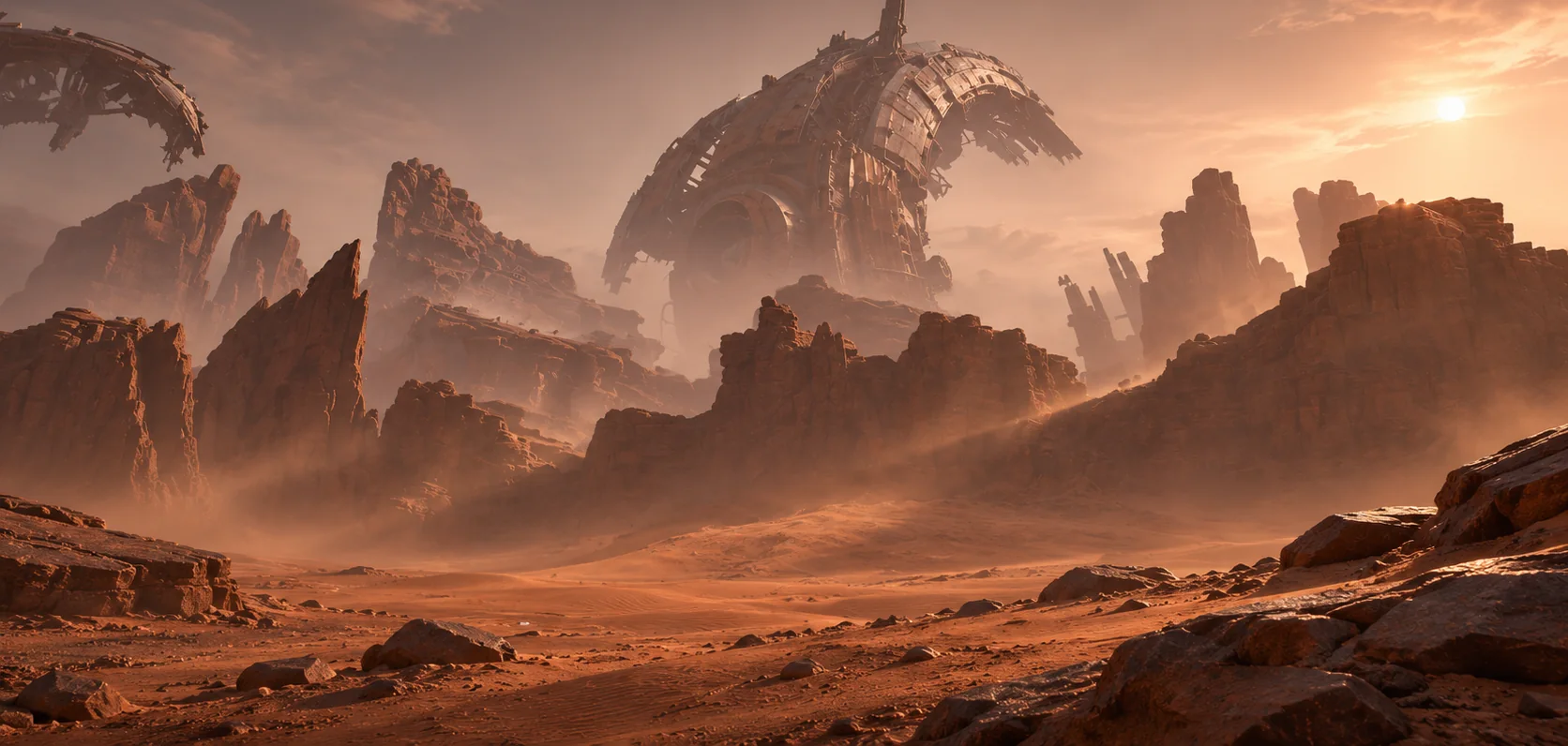
On January 1, 2026, I began working on AURORA. I wanted to create a game with a vast open world, but not one set on Earth. I imagined an unknown planet with its own harsh conditions—a place where a human being would have to figure everything out from scratch.
The original idea went beyond simply staying alive. I wanted a believable world governed by understandable physical rules. Pressing a single button and getting a finished result did not appeal to me. Every machine, every connection, and every resource should have a reason to exist.
The Only Survivor
The story begins with a spaceship crash. The protagonist is the sole survivor on an unfamiliar planet. There is no colony, no crew to help, and no functioning infrastructure. Everything needed to stay alive has to be built and maintained alone.
The world is enormous. AURORA is designed around a map spanning 32 kilometers. I wanted exploration to feel like more than a short walk between points of interest. It should be an essential part of survival, with unfamiliar terrain, enormous caves, geological formations, strange plants, and places the player knows nothing about at first.
The environment is intended to matter. The day–night cycle, weather, dust storms, meteor showers, and other hazardous phenomena should affect the conditions outside. Different vehicles are part of the longer-term vision, but even a simple resource expedition should require planning.
Building Something Is Only the Beginning
As the idea developed, engineering became its core. I did not want buildings to be merely objects placed on a foundation. I wanted them to connect into an infrastructure that actually works.
Electricity has to be generated, stored, and delivered through cables. Water must be found, extracted, processed, purified, and distributed through pipes. Equipment needs connections, materials, components, and maintenance. Manufacturing should follow complete production chains, from raw resources to finished machinery and structures.
The same principle applies to crafting. Minerals, metals, mechanical parts, electronics, and tools should serve specific purposes rather than exist only to fill an ever-growing list of recipes.
Over time, players should be able to build their own base, establish power and water networks, produce oxygen, grow food crops, and manufacture increasingly sophisticated equipment. All these systems are meant to depend on one another.
Without electricity, critical machines stop working. Without water, oxygen, or food, the character's survival is at risk. Without materials, equipment becomes harder to repair and expand. A functioning base should feel less like a collection of buildings and more like a system that must be kept alive.
When the Planet Gained Inhabitants
At first, I was mainly thinking about exploration, engineering, and survival. Later, another idea changed the direction of AURORA: what if this hostile planet had inhabitants capable of fighting back?
That is where the concept of aggressive, insect-like creatures emerged. I did not want conventional enemies that simply spot the player and rush forward along a predictable path.
Instead, I began imagining collective intelligence: a shared decision-making framework, group coordination, information exchange, reactions to losses, changing circumstances, and the player's actions. The goal is for each creature to feel like part of a living, responsive ecosystem rather than an isolated bot following a short list of commands.
With that came another major pillar: base defense.
Fortifications, sensors, automated turrets, and other defensive systems would be part of the same infrastructure as everything else. They would need power, ammunition, maintenance, and careful placement. Against adversaries that act together, a single wall should not be enough.
What AURORA Is Meant to Become
I want exploration, resource gathering, crafting, construction, manufacturing, life support, and defense to work together as parts of one coherent world.
It is an ambitious vision. Some elements are already being developed and tested; others remain to be built. I do not want to present planned features as if they were already finished.
But this is where AURORA began: one person on an unknown planet, a vast world to understand, and survival depending on the ability to make every hard-won system work together.