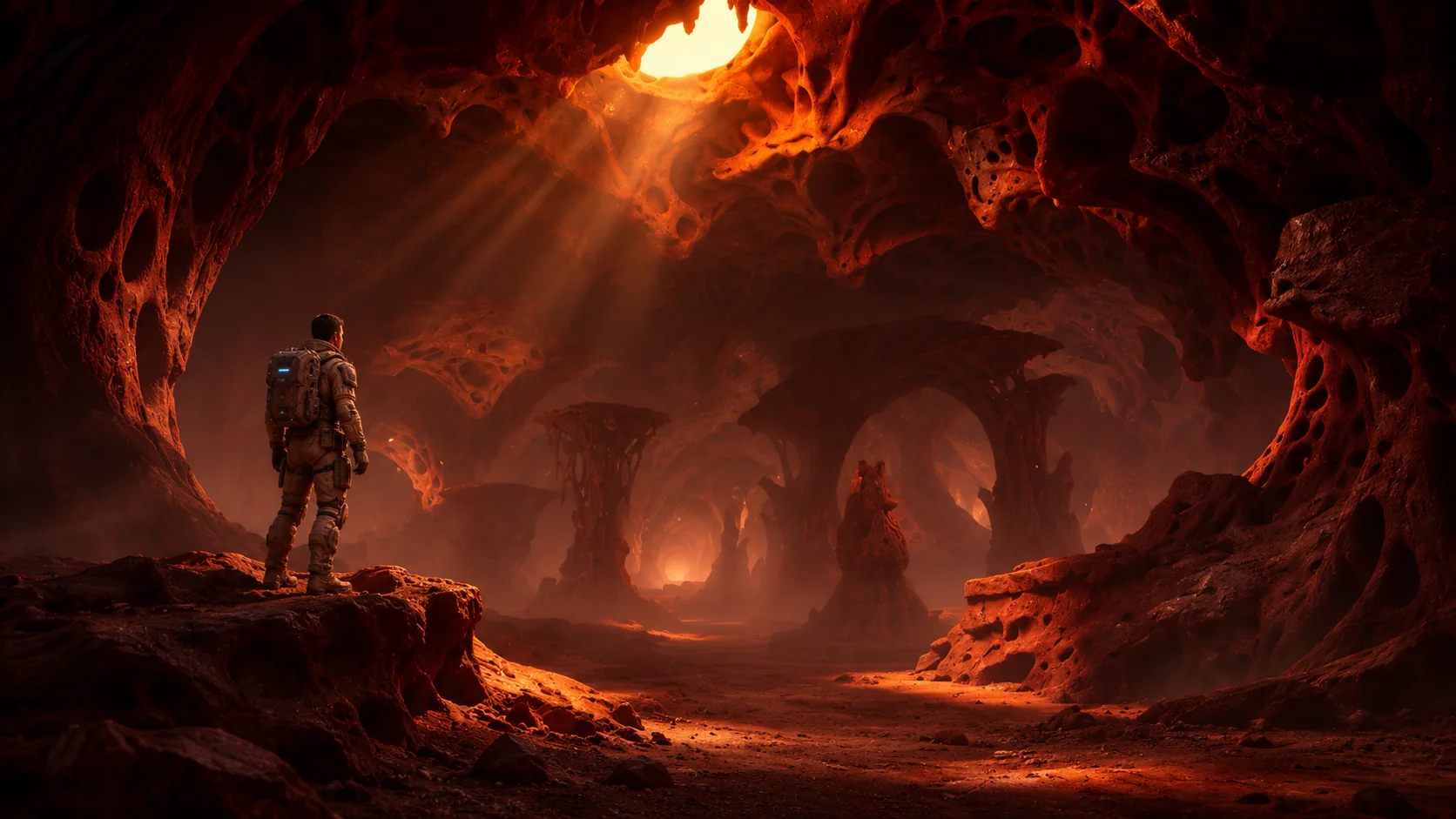
When I started imagining the inhabitants of AURORA, I quickly realized that I did not want ordinary enemies that appear nearby, charge at the player, and repeat the same attack.
If someone finds themselves alone on an unknown planet, one of the most frightening discoveries is that the world already has inhabitants of its own. They have no reason to accommodate the newcomer. They should live their own lives, notice an intrusion, and respond to it.
That led to one of AURORA's most ambitious ideas: aggressive, insect-like creatures that behave not as a collection of isolated bots, but as parts of a shared living system.
More Than Enemies on a Map
I want every creature to have a reason to be where it is. There should be territories, nests, routes, a population, and tasks of its own. Its presence should not be explained solely by the player entering another trigger area.
One or two creatures should be genuinely dangerous. A smaller group should force the player to change tactics. And if a large organized assault ever reaches a base, its scale should follow from events in the world—not from an arbitrary wave timer.
That is why the creature system operates on several levels. An individual has its own senses, memory, body condition, and ability to choose actions. A group shares signals and assigns roles. A nest coordinates nearby territory, while the wider hive maintains a broader picture and longer-term intentions.
I do not want to build a separate AI brain for every caste or body type. The foundation should be one shared decision framework, extended with different physical abilities, actions, and constraints.
Information Cannot Appear from Nowhere
The most important rule for me is that the enemy must not know everything simply because the game engine knows it.
If a scout spots the player, that does not mean the entire hive instantly receives perfect coordinates. Information has to travel. It can become outdated, incomplete, or lost before it reaches anyone else.
The system we have already built allows a scout to survey an area, detect the player with its own senses, and carry an observation back to a nest. Another carrier then delivers the report to the hive. If a carrier dies before delivering it, that information may never arrive.
The hive now has a form of memory that tracks observations, their sources, and how confident it is in them. It can assign a scout to revisit an area when the evidence is uncertain or old. If the scout finds nothing, confidence decreases, but the earlier sighting does not magically disappear.
That distinction is fundamental. The hive should draw conclusions from information it actually receives, not read the player's live position straight from the game world.
For now, however, this memory primarily concerns sightings of the player. Scouting buildings, studying turrets, and learning the player's long-term habits are directions for future development, not finished features.
What Happens When a Group Loses Coordination
Another idea is that a group should have more than strong fighters. Some individuals should help the others act together.
That is the purpose of the Signaller role. It spreads an alarm and helps coordinate pressure: who leads, who attacks from another side, and who waits for an opening.
We have already tested this type of coordination in the game. When the Signaller dies, the group loses part of its coordination, experiences a brief period of confusion, and can no longer organize certain synchronized actions.
But I deliberately do not want the death of one creature to turn the others into helpless targets. Each individual remains dangerous. It can still perceive a nearby threat, defend itself, attack, and choose its own actions.
For now, the Signaller and Scout use temporary variants of the first Warrior creature. These are tests of behavior and architecture, not their final models, animations, or complete biological roles.
A Body Must Influence Decisions
Intelligence should not be separate from a creature's physical condition. If it is injured or loses a limb, that must change what it can actually do.
The project already has systems for damage to body parts, changes in mobility, and restrictions on available actions. A creature should not try to perform an action that its damaged body can no longer support.
Movement is another challenge. Creatures need to navigate around walls and rocks, respond to obstacles, avoid chasing unreachable points forever, and not attack a player through impossible height differences.
Recent gameplay tests have confirmed progress on these problems. We are also developing subtler ways for creatures to sense their surroundings. For example, movement on nearby ground can produce a vibration cue, even before the creature sees what caused it. A player standing still behind it is not automatically detected.
I want this behavior to feel understandable, never like an opponent that cheats.
Losses Have to Matter
An endless stream of enemies quickly turns defense into a competition over ammunition. I am more interested in a different approach.
A hive should have a population, and losing members should have consequences. Destroying a group should not cause an identical replacement to appear instantly and for free.
AURORA already has tested systems for tracking living and dead creatures, switching between active simulation and a lighter representation far from the player, moving distant groups without constantly rendering them, and limited nest replenishment. In one mechanism, creating a new creature takes time and a finite resource, rather than relying on a simple attack-wave timer.
That is not the same as a finished ecosystem. Biomass collection, the behavior of creatures around corpses, a complete nest life cycle, and the long-term strategy of the population still need further development.
For now, these systems provide a foundation.
When Survival Becomes Defense
As the creatures' intelligence took shape, I realized that gathering resources and building machines would not be enough. Eventually, the player would need to protect everything they had created.
I do not want a survivor carrying a handheld weapon to casually defeat an entire pack of dangerous creatures. The player's greatest strength should come from preparation, infrastructure, and a carefully designed base.
That leads to automated defense systems: sensors, fortifications, and different classes of turrets. In my vision, they need electricity and ammunition, have limitations, and require maintenance. When defenses lose power or run out of supplies, the consequences should be felt.
Eventually, the enemy should be able to scout routes, recognize dangerous approaches, and alter its tactics. That would make base defense more than simply building a tall wall. Terrain, access routes, power, repairs, and the placement of machines would all matter.
These are still design goals. Full assaults on player bases, learning turret layouts, and a complete network of automated defensive machines have not been finished.
But the meeting of engineering survival and an intelligent opponent is intended to become one of AURORA's defining features.
An Enemy You Can Understand
I am not trying to create a creature that always knows the right answer. Quite the opposite: a good opponent should be able to make mistakes, lose information, react too late, and pay a real price for its decisions.
The player should be able to spot a scout, intercept a message, take out a Signaller, change routes, mislead an observation, or exploit the hive's losses. The smarter the hive becomes, the more meaningful ways the player should have to respond.
The first layers of this system have already been implemented and tested in Unreal Engine: individual behavior, groups, nests, physical information delivery, observation-based memory, and obstacle recovery. Full gameplay validation, ecosystem development, and tests in a packaged build still lie ahead.
One day, I want players to see a change in creature behavior and think not 'the game increased the difficulty,' but 'they learned something about me.'
And I want defending a base built with your own hands to matter just as much as learning how to supply it with water, oxygen, and electricity in the first place.