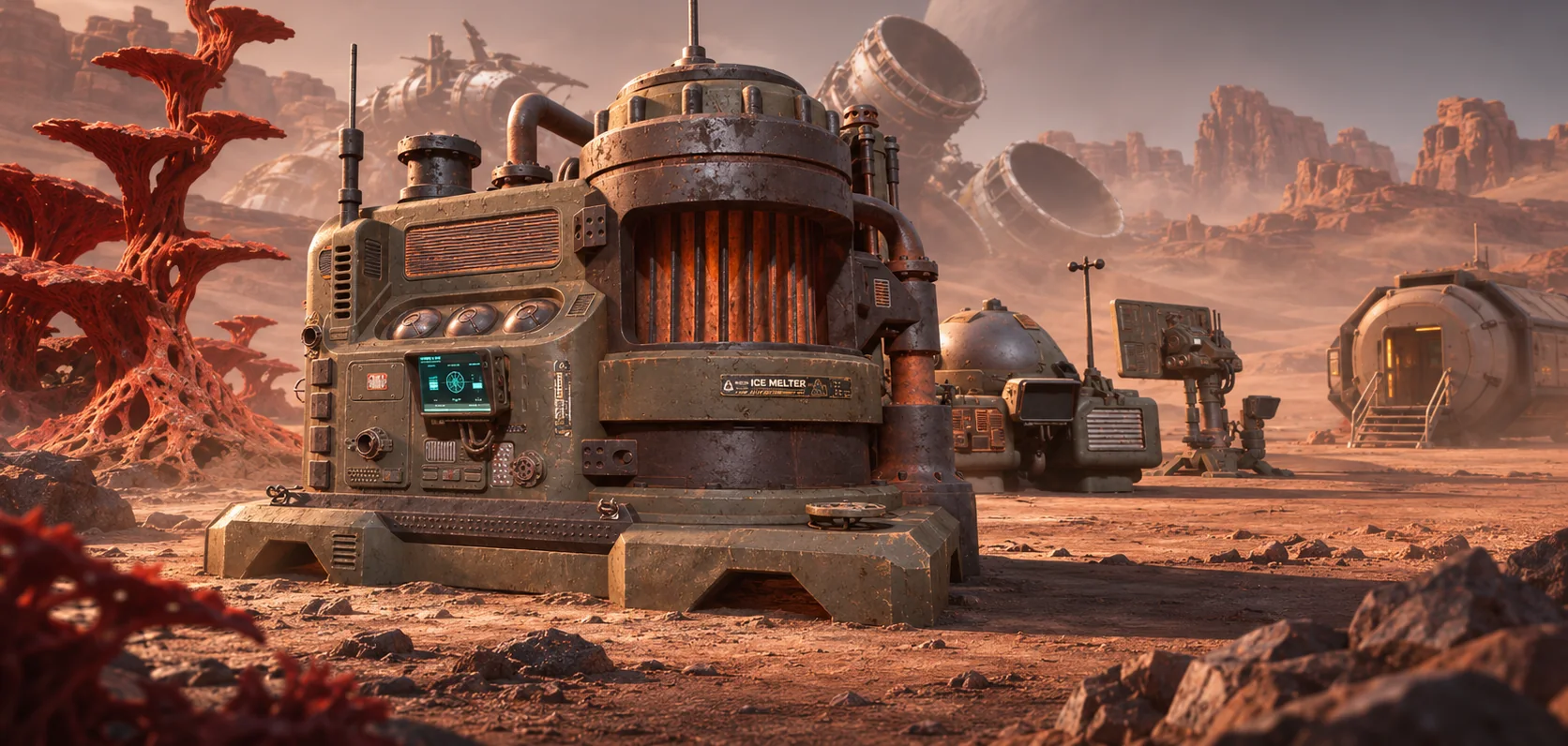
In many survival games, you gather a few resources, select a building from a menu, and place it wherever you like. I wanted to go further. I envisioned AURORA as a world where machines do not simply stand next to each other: they are connected and depend on one another.
If something runs on electricity, that power must come from somewhere. If it processes raw material, it needs a supply—and somewhere to send the result. A base should not be decoration. It should be the system keeping the planet's only survivor alive.
Nothing Works by Itself
For me, engineering survival starts with a simple question: what does this machine need to function?
A finished body is not enough. It needs materials, a connection, power, input resources, and perhaps somewhere for its output to go. If one requirement is missing, the machine may stop.
I wanted to move beyond abstractions where electricity reaches an entire base because a generator happens to be nearby, or water appears out of nowhere. Cables, pipes, connectors, ports, and storage should all have a clear purpose.
That is why AURORA is being built around separate power and resource connections. Buildings have inputs and outputs, and their connections are intended to account for what is actually transported between them. The technical foundation already exists, though the full network of machines still needs further integration and gameplay testing.
From Stone to a Working Machine
Before building complex equipment, you need materials. Here too, I wanted to avoid the feeling of resources simply dropping from an object after a button press.
AURORA has a developing rock-mining system: resource rocks can break into physical fragments that the player then collects. Different deposits have their own characteristics, and a tool's effectiveness matters.
Parts of this system have already undergone focused tests, including resource accounting, fragments, and tool behavior. Balancing and integration with the larger open world are still ongoing.
I see resources not as a collection of inventory icons but as the beginning of a technological chain. Ore becomes material; material becomes a component; the component becomes part of a machine. More sophisticated equipment should depend on more of these processes.
The same idea applies to crafting. Electronics, tools, mechanical assemblies, and construction materials should exist to solve particular problems—not simply to make the recipe list longer.
Even Water Needs Infrastructure
Water is a good example of how I want the systems to fit together.
On an unknown planet, discovering ice is not enough. It has to be extracted, stored, processed, purified, and delivered to wherever it is needed. Water may be essential for the character, for equipment, and eventually for life support and growing food.
The project already contains work on several devices for this chain: a water-ice extractor, ice storage, an ice melter, a raw-water tank, a purifier, and storage for the processed product. Resource ports are intended to connect them.
Power is an essential part of this process. A melter or purifier should not keep running without electricity. Processing must also account for available inputs and room for the output.
Several mechanisms for handling machine states have already been implemented and examined at source level. But I do not want to claim that every step—from an underground deposit to every consumer of purified water—is a finished, end-to-end gameplay feature. Further integration and packaged-build tests are still needed.
That is the kind of logic I want to extend throughout manufacturing, from simple devices to complex industrial facilities.
Electricity Is a Condition for Life
Power generation and distribution should become some of the most important systems on a base. Producing electricity is only part of the challenge; it must also reach the machines that need it.
AURORA already has work underway on power networks, ports, energy sources, and storage. A building's connection to the network and the network's current state are meant to affect whether it can operate.
I like the idea that a power shortage should lead to more than an abstract warning on the screen. Production might stop. Water purification might go offline. Life support might become endangered. In time, the same concern should apply to automated defenses.
That is why power cannot be treated as a separate minigame. It should encourage players to think about loads, backups, and where equipment is placed. How far these mechanics can go will depend on further development and testing.
A Home That Has to Stay Alive
Over time, the player should be able to grow a small shelter into a functioning infrastructure. I want them to understand what keeps the air inside their home safe to breathe.
Work is underway on engineered habitats, doors, and airlocks. One version of the habitat, for example, includes development of door controls, sealing, and displays for atmospheric conditions. Parts of this exist in code, while visual and gameplay acceptance checks are still outstanding.
Eventually, this infrastructure is meant to support oxygen, water, food crops, storage, and other life-support systems.
This is where the central idea of AURORA comes together. Losing energy, water, oxygen, or materials should not be a set of unrelated status bars. It should form a chain of causes and consequences. Fixing one problem might require repairing another machine, finding new resources, or traveling far beyond the safety of the base.
Building It Is Only Half the Job
I do not want to make every action complicated merely for the sake of complexity. What matters is understandable logic: if a player spends time building a machine, they should know what it does, where its resources come from, and what happens when it stops working.
Some engineering mechanics already exist and are undergoing technical checks. Others remain at the design stage or have yet to be combined into a single working system. There is still a great deal to do in connection usability, balancing, automation, and testing everything in actual gameplay.
But this is the AURORA I want to create: a survival game built not around one magical structure, but around a whole infrastructure that the player builds with their own hands—and takes responsibility for keeping alive.