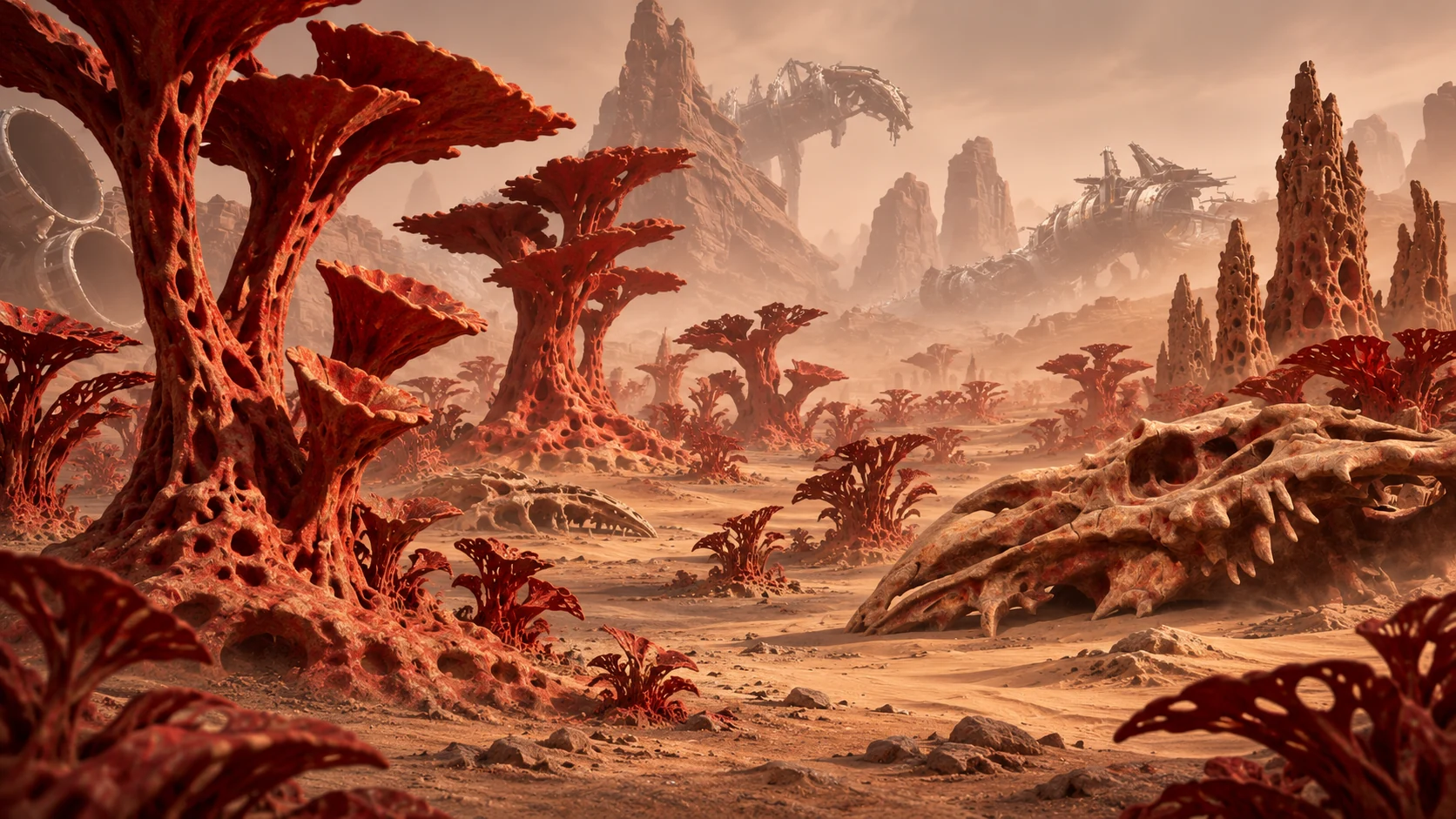
From the beginning, I did not want AURORA's planet to be just an enormous desert filled with randomly placed resources and buildings. I want it to feel like a place that existed long before the spaceship crashed. Even when the player is doing nothing, the landscape should raise questions: what grew here, what left these traces, and why does the world look this way?
That is why I am working on more than the map's size and the shape of its cliffs. One of the most important challenges is finding a visual language for alien nature. Not Earth trees recolored for science fiction, but forms that are difficult to compare with anything familiar at first glance.
Crimson Organic Shapes
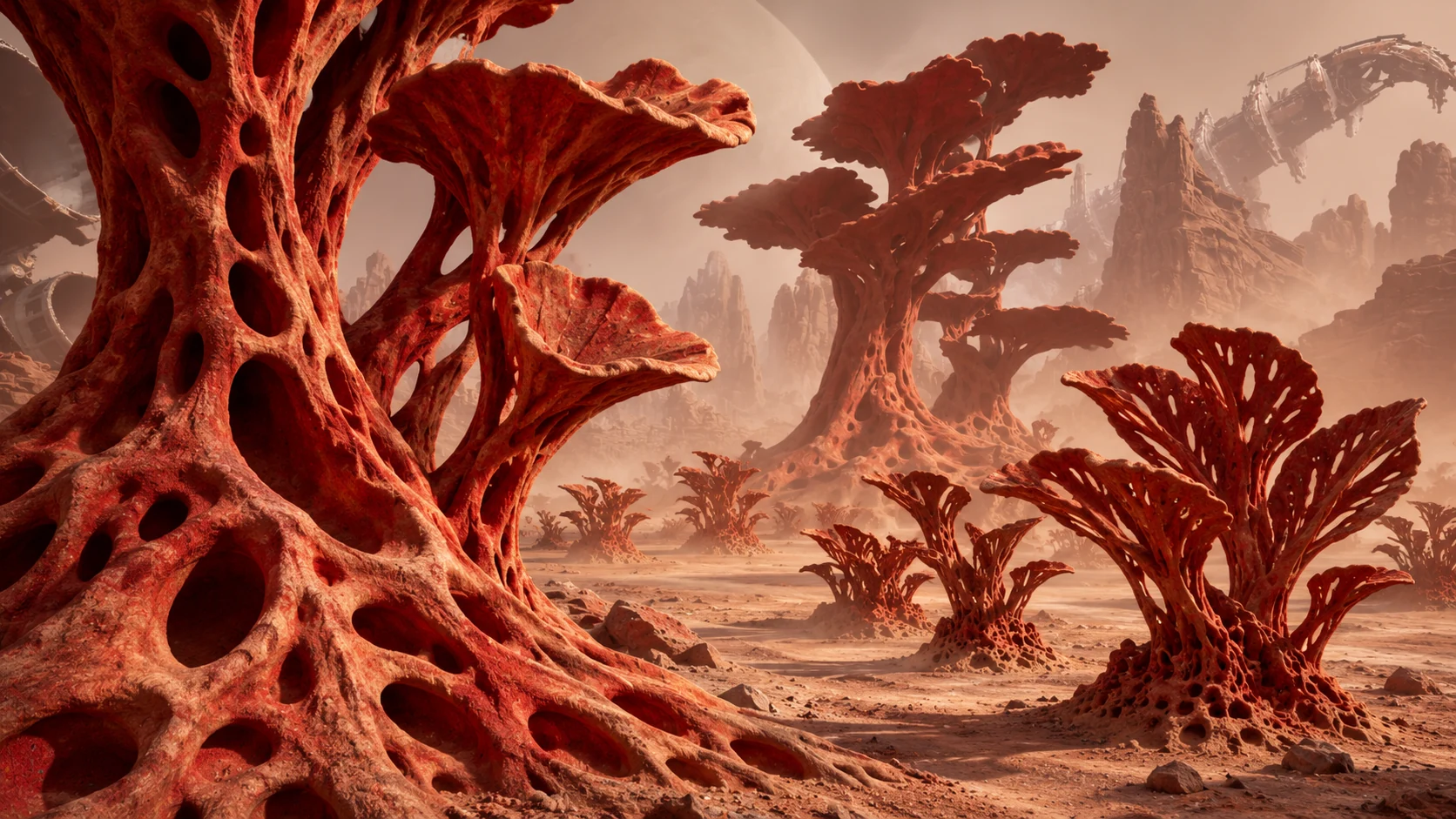
The first kinds of alien vegetation are taking shape in AURORA. Some are massive structures with broad, fan-like canopies, porous bases, and heavy trunks pierced by openings. Smaller growths nearby have irregular plates, perforations, and branching shapes of their own.
These forms need to work at different distances. From far away, their silhouettes should feel immediately unfamiliar. Up close, the player should notice the cavities, edges, layers, and surfaces that seem to sit somewhere between stone and living tissue. Details like these can give AURORA's environment an identity of its own.
I do not want the plants to look like plastic props. They should have a sense of weight, structure, and character, even while their fictional biology remains to be developed.
From Individual Models to Natural Clusters
Making an interesting model is only the beginning. Scatter even the best-looking plants evenly across a landscape, and the result feels like a designed garden rather than an unknown ecosystem.
So I have also been testing how these objects come together. Where should the largest forms stand? How densely should the smaller ones grow? How much empty ground should separate clusters? What kind of shape should the whole colony form when seen from a distance?
Early experiments have shown that this is more difficult than adjusting a single density value. Sometimes the vegetation merges into one broad but sparse mass. Sometimes individual plants remain too isolated to create a convincing overall silhouette. I am still looking for the point where the arrangement feels naturally structured rather than randomly generated.
These are not finished biomes. Plant placement, scale, variation, and the transitions between different areas will continue to change. The artwork accompanying this entry explores the intended atmosphere; it should not be mistaken for an exact capture of a completed in-game environment.
Traces of What Came Before
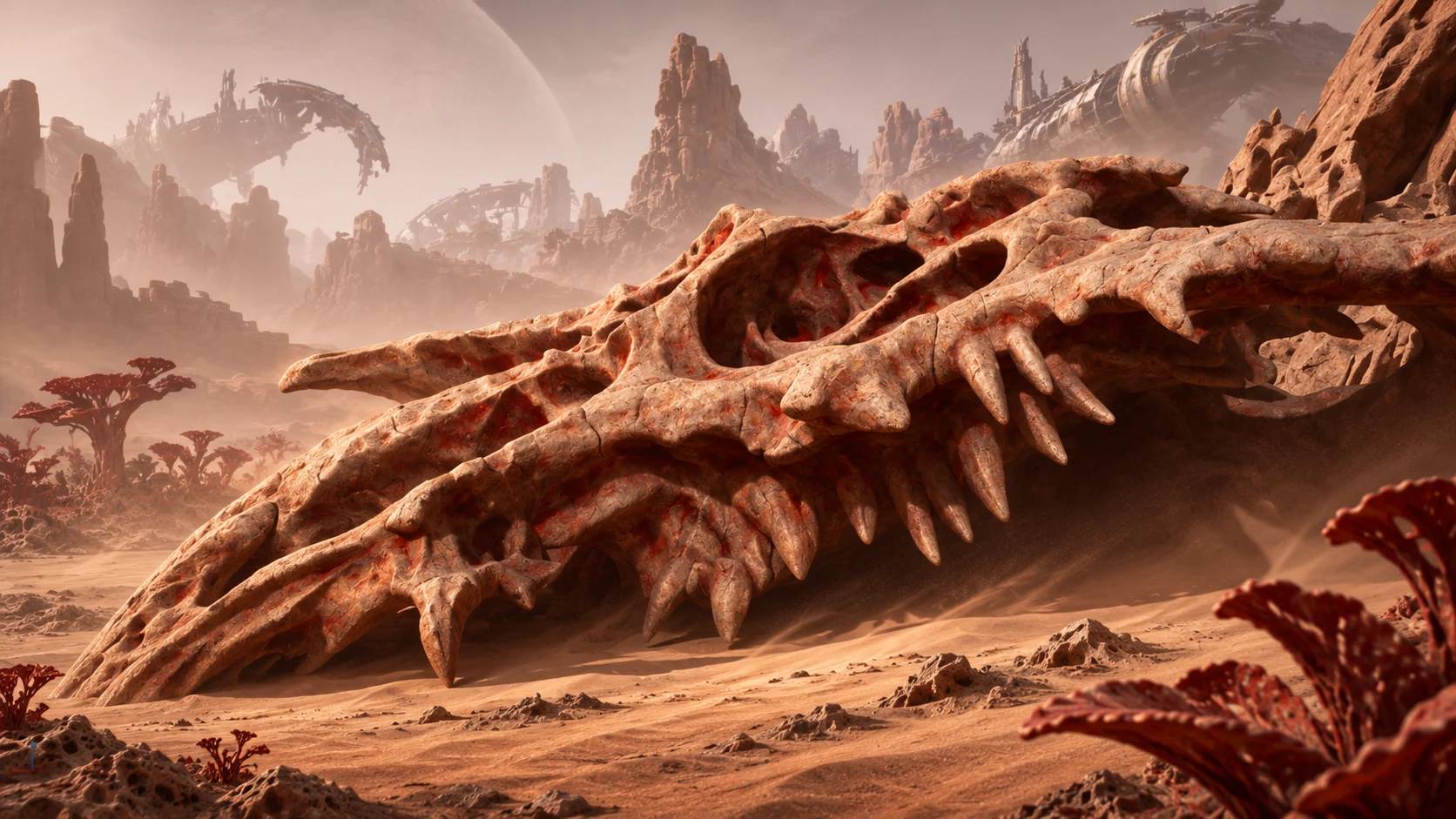
Alongside the vegetation, I am designing other natural-looking objects: enormous fossilized organic remains. They include skull-like shapes, sections of shell, porous husks, and structures that suggest bones without always fitting an easy classification.
I like the way such objects can suggest a history without a single line of dialogue. The player does not simply see a rock or an ornament. They encounter evidence of something vast and unfamiliar that may have existed on the planet long before they arrived.
I am not ready to claim that every fossil belongs to a particular species, or that a complete archaeological investigation system already exists. For now, I am exploring scale, silhouettes, textures, and how these remains belong in the surrounding terrain. Their final place in the world's history is still being worked out.
The Space Between Discoveries
On a map spanning 32 kilometers, what lies between points of interest matters just as much as what stands directly in front of the player. I want long empty stretches and great distances to contribute to the atmosphere.
If a dense colony of strange plants or a gigantic fossil suddenly emerges among otherwise bare cliffs, it should feel like a discovery. That effect depends on variation. The entire world cannot be equally full of landmarks; it needs recognizable regions, changing densities, and convincing transitions between them.
That is why I continue experimenting with vegetation, terrain materials, rocks, and larger organic structures in combination. Some of the results can already be seen in Unreal Engine, but the work of bringing them into one coherent environment is far from finished.
Only the Beginning
Ultimately, I want AURORA's environment to be inseparable from survival and exploration. The player should gradually learn to read the planet, use its natural formations to navigate, and discover places unlike anything they have seen before.
Today, I am working on individual models, their materials, and early natural compositions. Ahead lies more variation, better control of vegetation density, and the challenge of making it all convincing across a very large world.
For now, I can show the direction: crimson porous flora, unfamiliar organic structures, and traces of an unknown past. This is not the final world of AURORA. It is an early step toward making a desert feel like a planet with its own identity.