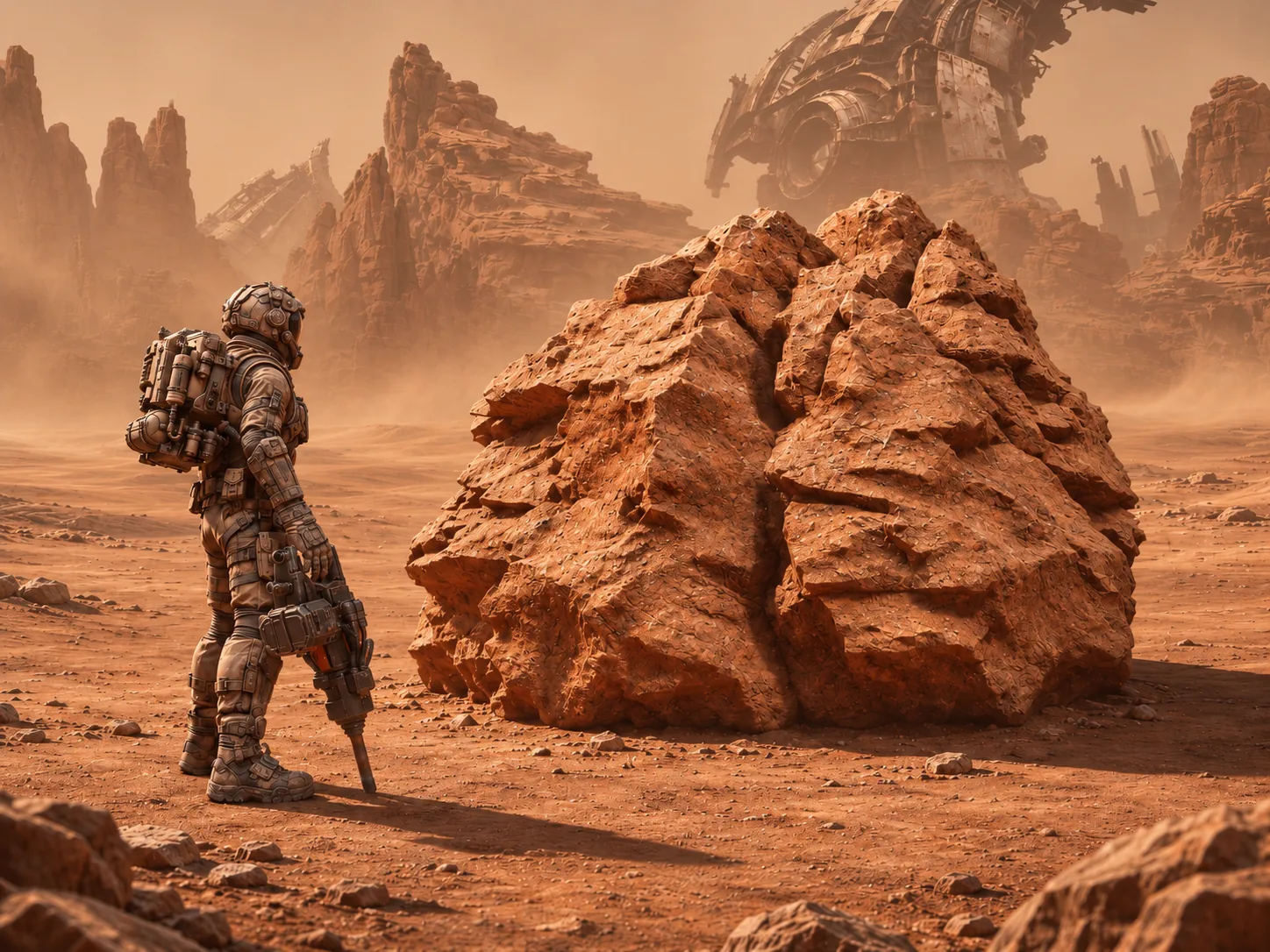
When I first planned resource mining for AURORA, I wanted to move beyond the familiar shortcut: walk up to a rock, press a button, and receive a few units of ore. That would not be enough for a world built around physical behavior and interconnected engineering systems.
I want mining to feel like real work. The player finds a deposit, chooses a suitable tool, breaks the rock apart, and then collects the resulting fragments. Different rocks have different properties, while tool performance and resource yield follow consistent rules.
This system already exists as the RockV2 gameplay prototype and has undergone focused checks. Its visual behavior, fragment physics, and balancing are still being improved.
First, Find a Deposit
The opening image shows an intact resource rock in AURORA's rocky wasteland. These deposits should feel like part of the terrain, not game containers randomly scattered across the surface.
Rocks can vary in shape and size. Their placement uses a world-distribution system that accounts for resource type, terrain, and restrictions near structures. That helps avoid manually placing every deposit across a vast map.
Size is not purely decorative: in RockV2, the amount of material is linked to parameters of an individual rock. Final distribution density and the appearance of deposits across the larger world still require additional validation.
The Tool Matters
The most recognizable mining tool at this stage is the jackhammer. I want it to feel like a heavy industrial machine, not an abstract 'mine' button.
In RockV2, efficiency depends on the tool and the resistance of the material. Some rocks break relatively quickly; others require more work. Focused tests have examined how these parameters affect mining.
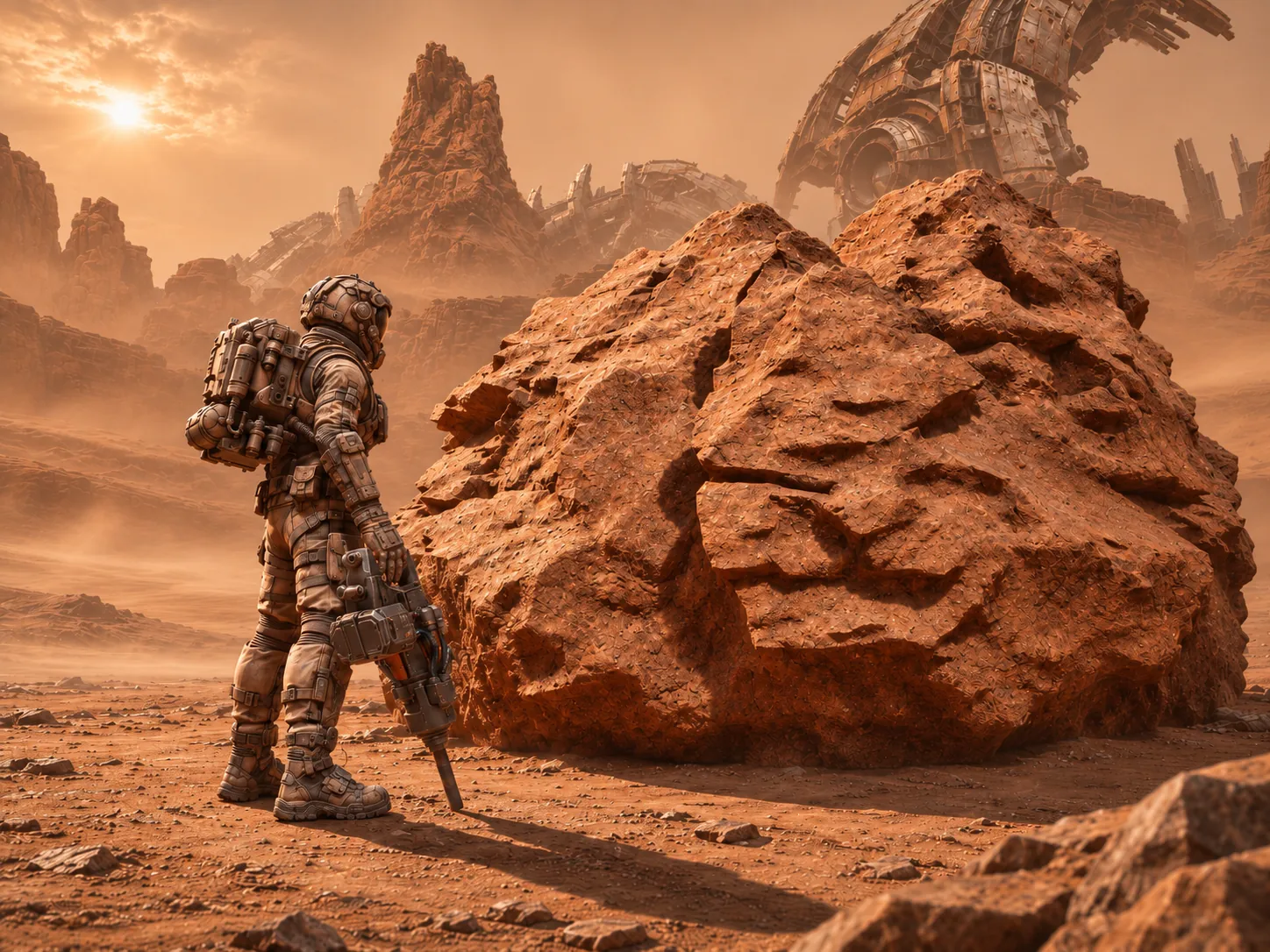
Here, the survivor stands beside a deposit holding the jackhammer. This image shows the tool and the scale of the rock, but it is not a frame-by-frame recording of the tool striking the surface.
What Remains After Breaking
The defining feature is that rock can break into large physical fragments. The player does not simply receive a notification: the fragments exist in the world and can be collected.
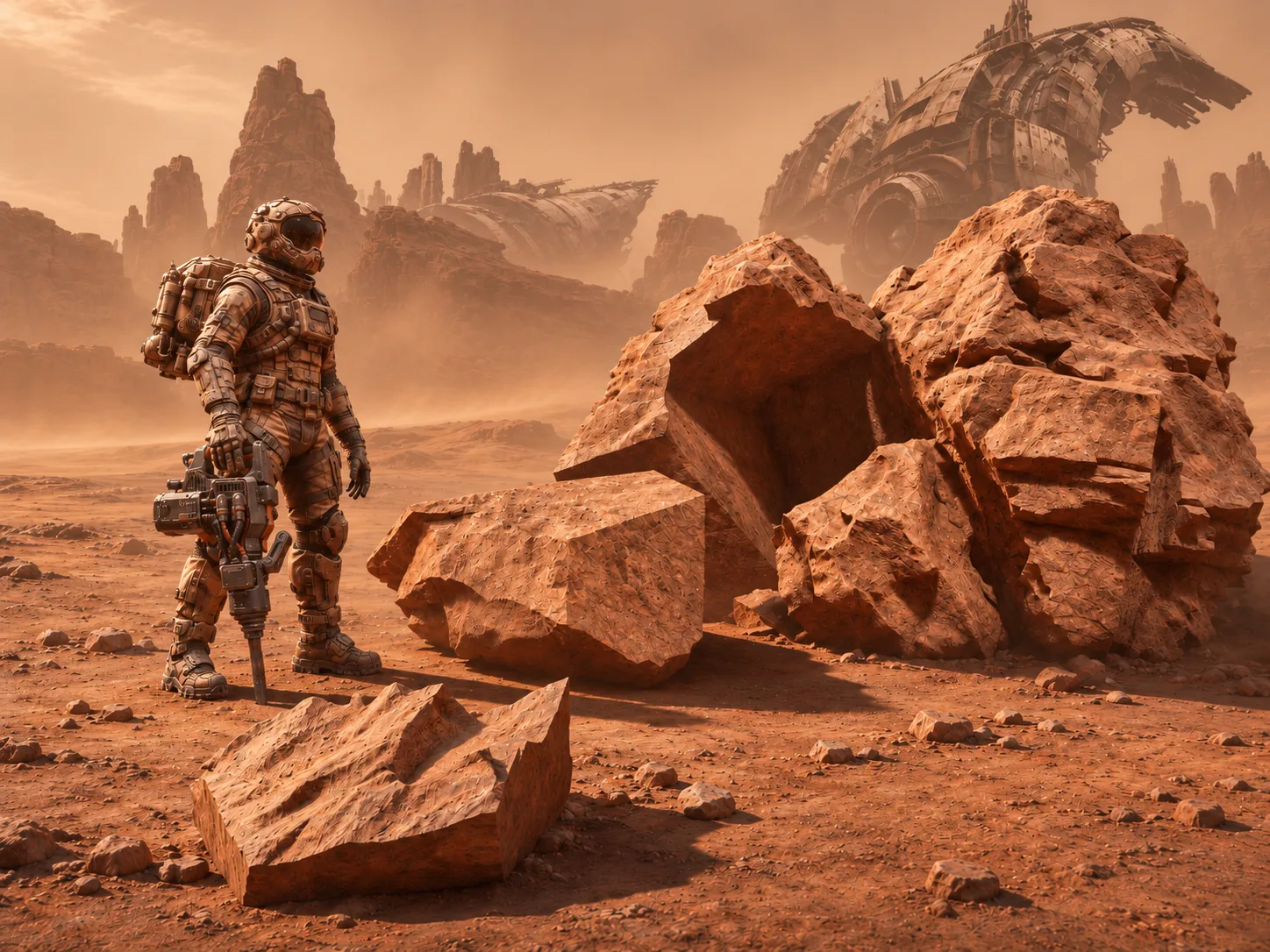
Resource accounting must remain consistent throughout. In one tested scenario, the system correctly accounted for 66 units of material across 26 fragments. Physical destruction should not duplicate resources or lose part of the yield.
Fragment mass and movement are also being refined. A large piece of rock should not behave like a weightless prop. The physics system considers volume, material density, and velocity limits, while the physical mass of a fragment is kept separate from its inventory weight.
Some of these changes are already implemented in code, but the visual feeling of weight and fragment motion still needs further in-game acceptance testing.
Mining Is Only the Beginning
For me, gathering a rock is not the end of the mechanic. Eventually, raw materials should flow into production: construction materials, components, tools, machines, and new structures.
That is why resources need to feel tangible. Players should understand where they come from, what it takes to extract them, and what they will enable next.
At this stage, RockV2 is a working foundation rather than a finalized system. Further work remains in physics, balance, deposit placement, and integration with the broader production chains.
This is how engineering survival in AURORA is taking shape: one tangible, testable system at a time.
The images in this story are artistically edited from real development materials. They illustrate the mining sequence and visual direction, but they are not unedited gameplay screenshots or a frame-by-frame gameplay recording.